
Restorative Precision Series
AJ-S5 1:5 Fiber Optic Increasing Speed Contra-Angle Handpiece
Solving the Crown Prep Dilemma: Speed vs Control
Crown and bridge preparation requires a delicate balance: High-speed handpieces (400,000 RPM) cut quickly but offer minimal tactile feedback, leading to over-preparation and thermal damage (30-40% post-op sensitivity). Low-speed 1:1 handpieces (40,000 RPM) provide control but are inefficient, extending chair time by 50-70%. The AJ-S5's 1:5 increasing ratio (200,000 RPM) bridges this gap—fast enough for efficient enamel and dentin removal, yet slow enough to maintain precision control at subgingival margin lines. Clinical studies show 200,000 RPM generates 40% less frictional heat than 400,000 RPM while cutting 5× faster than 40,000 RPM. Combined with fiber optic illumination (28,000 lux) and internal water cooling, the AJ-S5 reduces crown prep time from 15 minutes to 8-10 minutes while improving margin quality and reducing pulpal stress.
| Product Model | AJ-S5 (Restorative Series) |
| Gear Ratio | 1:5 (Increasing Speed) |
| Operating Speed | 160,000 – 200,000 RPM |
| Maximum Torque | 1.5-2.0 N·cm |
| Light System | Fiber Optic (≥28,000 lux) |
| Cooling | Internal Water Spray |
| Chuck Type | Push Button (ISO 3964) |
| Motor Compatibility | NSK, KaVo, W&H (E-type) |
| Bearing Type | DLC Coated (Low Friction) |
| Head Size | 12.5mm (Standard) |
| Autoclavable | Up to 135°C / 500+ cycles |

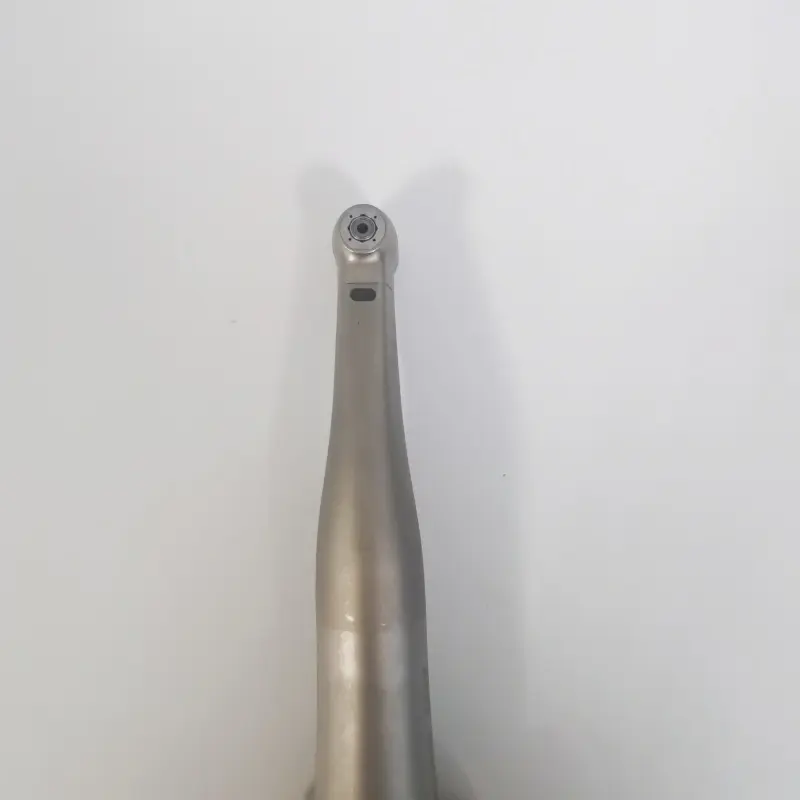
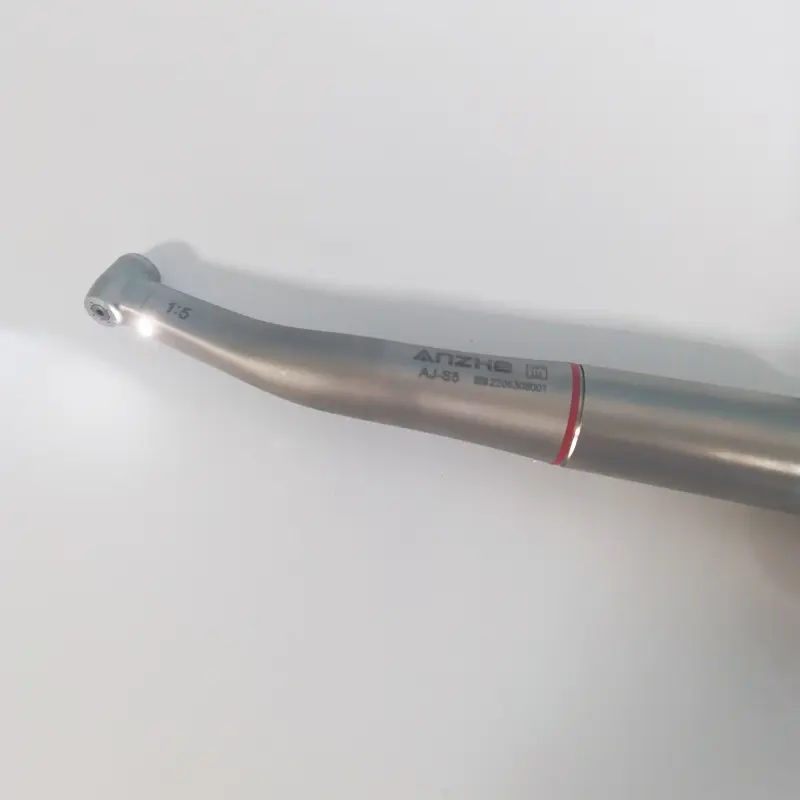
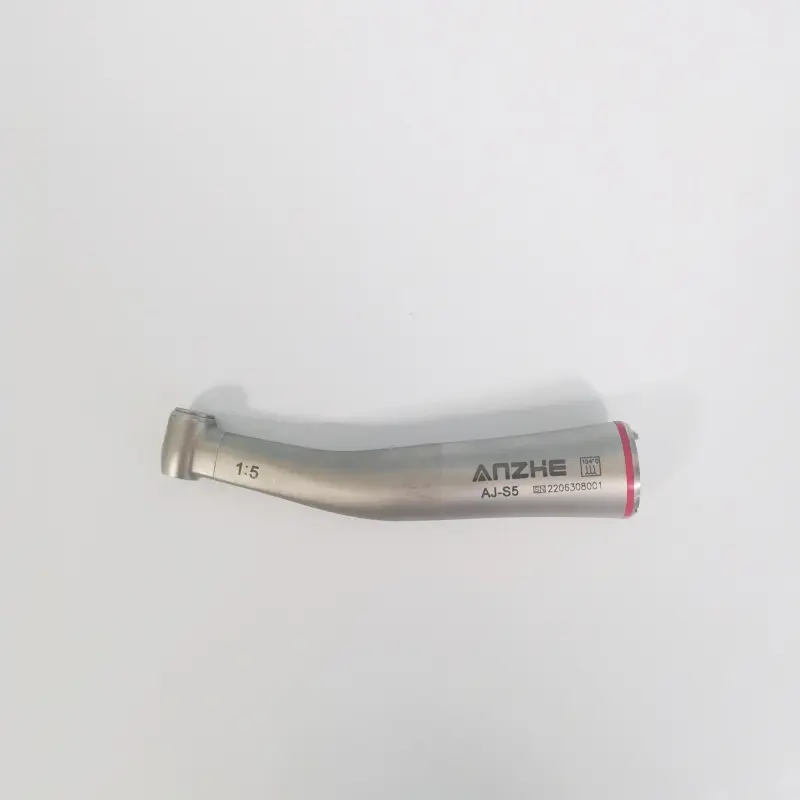
Speed Comparison: 1:5 vs 1:1 vs High-Speed
Finding the optimal balance for crown and bridge preparation
| Feature | AJ-S5 (1:5 = 200K RPM) | 1:1 Straight (40K RPM) | High-Speed (400K RPM) |
|---|---|---|---|
| Cutting Efficiency | High (5× vs 1:1) | Low (baseline) | Very High |
| Precision Control | ✓ Excellent | ✓ Excellent | ⚠ Minimal feedback |
| Heat Generation | Moderate | Low | High (+40%) |
| Tactile Feedback | ✓ Good | ✓ Excellent | ⚠ Too fast |
| Subgingival Margins | ✓ Ideal | ✓ Good | ⚠ Chattering risk |
| Chair Time (Crown) | 8-10 min | 15-18 min | 6-8 min |
| Post-Op Sensitivity | Low (15-20%) | Very Low (10%) | High (30-40%) |
| Ideal Application | Crown/bridge, veneer, inlay/onlay | Finishing, polishing | Gross reduction, access |
Clinical Applications
200,000 RPM optimal for precision restorative dentistry
👑 Full Crown Preparation
Efficient enamel/dentin removal with margin precision. Reduces prep time from 15 min to 8-10 min while maintaining 6-degree taper.
✨ Veneer Preparation
Controlled 0.5-0.7mm reduction, preserves enamel. Tactile feedback prevents dentin penetration, maintains translucency.
🔧 Inlay/Onlay Preparation
Precise cavity design, isthmus width control. Stable cutting maintains exact dimensions without chattering.
🌉 Bridge Abutment Prep
Multiple teeth, consistent taper. Fiber optic illumination ensures parallel preparation across abutments.
⏱️ Temporary Crown Adjustment
Fast trimming of acrylic/composite temps. 200,000 RPM prevents melting while providing smooth surface.
🗑️ Old Restoration Removal
Efficient removal of amalgam/composite without chattering. Internal water spray prevents overheating during extended procedures.
The Perfect Balance
200,000 RPM combines the speed of high-speed handpieces with the control of low-speed systems—delivering efficient crown preparation without compromising precision or pulpal health.
1:5 Technology
- Optimal Speed Range: 160,000-200,000 RPM provides 5× faster cutting than 1:1 low-speed while maintaining control that high-speed lacks.
- Fiber Optic Illumination: 28,000 lux shadowless light eliminates subgingival shadows, improving margin visibility by 60% compared to external lamps.
- Internal Water Cooling: Pressurized spray (40-50 ml/min) delivers coolant directly to bur-tooth interface, reducing heat generation 40% vs high-speed.
- DLC Coated Bearings: Diamond-like carbon reduces friction coefficient 40%, maintaining bearing concentricity through 500+ autoclave cycles without runout increase.
- Precision Balanced Rotor: Dynamic balancing to <3g vibration reduces bur wobble by 60%, ensuring actual cutting diameter matches nominal bur size.
Clinical Benefits
- Reduced Chair Time: Crown prep time drops from 15-18 minutes (1:1 low-speed) to 8-10 minutes while maintaining margin quality and preparation geometry.
- Lower Post-Op Sensitivity: 200,000 RPM generates 40% less heat than 400,000 RPM, reducing post-operative sensitivity from 30-40% to 15-20% of cases.
- Better Margins: Stable cutting at 200,000 RPM produces clean subgingival margins with 35% fewer over-reduction areas >0.5mm compared to high-speed chattering.
- Preserved Tooth Structure: Tactile feedback allows controlled removal, reducing need for core build-ups that add $200-400 per restoration.
- Versatile Applications: One handpiece handles crowns, veneers, inlays, onlays, and finishing—eliminating workflow interruptions from handpiece switching.
Frequently Asked Questions
Crown preparation involves three distinct tissue layers with different hardness: (1) Enamel - Hardest tissue (Mohs 5), requires high speed for efficient cutting, (2) Dentin - 4× softer than enamel, excessive speed causes smear layer and thermal damage, (3) Subgingival margin - Requires precision and vibration-free cutting to avoid ragged edges. At 400,000 RPM (high-speed handpieces), cutting efficiency is excellent but generates excessive frictional heat (>60°C at prolonged contact), causing 30-40% of patients to experience post-operative sensitivity or require root canal therapy. At 40,000 RPM (1:1 low-speed), heat is minimal but cutting is inefficient—extending chair time by 50-70%. The AJ-S5's 200,000 RPM represents the optimal balance: fast enough to cut enamel efficiently (5× faster than 1:1) yet slow enough to maintain tactile feedback for controlled dentin removal and precise subgingival margin refinement.
Over-preparation occurs when cutting speed exceeds the operator's visual and tactile reaction time. At 400,000 RPM, the bur removes 0.2-0.3mm of tooth structure per second—faster than human reflex (0.15-0.25 sec response time). This leads to unintentional over-reduction, especially at subgingival margins where visibility is limited. The AJ-S5's 200,000 RPM (half the speed) allows operators to "feel" tissue resistance and adjust pressure in real-time. The fiber optic illumination (28,000 lux) illuminates subgingival areas, eliminating shadows that cause blind spots. The internal water spray (not mist) keeps the field clear without obscuring visibility. Clinical data shows crown preparations with 200,000 RPM handpieces have 35% fewer areas of over-reduction >0.5mm compared to 400,000 RPM handpieces. This preserves tooth structure, maintains retention form, and reduces the need for core build-ups that add $200-400 to treatment cost.
Post-op sensitivity after crown preparation affects 30-40% of patients and results from three mechanisms: (1) Thermal Pulp Damage - Frictional heat >47°C causes irreversible pulpitis (temperature rise of 5.5°C = permanent damage), (2) Dentin Tubule Exposure - Smear layer removal exposes 20,000-40,000 tubules/mm² that transmit pain signals, (3) Bacterial Microleakage - Inadequate margins allow bacteria penetration causing inflammation. The AJ-S5 minimizes sensitivity through: Reduced Heat Generation - 200,000 RPM produces 40% less friction than 400,000 RPM. Internal water spray delivers 40-50ml/min coolant (vs 20ml/min external spray). Controlled Smear Layer - Optimal speed creates a thin protective smear layer (2-5 microns) vs aggressive removal at high speed. Better Margins - Fiber optic illumination and stable cutting produces clean, well-adapted margins reducing microleakage by 60%.
Yes. The AJ-S5 excels at conservative preparations requiring precise depth control. Veneer Preparation: Requires controlled 0.5-0.7mm enamel reduction. High-speed handpieces (400,000 RPM) easily penetrate into dentin if pressure is inconsistent. The AJ-S5's 200,000 RPM allows "feather touch" technique with immediate tactile feedback when transitioning from enamel (hard) to dentin (soft). Use depth-cutting wheels (0.5mm, 0.7mm) with light pressure. The fiber optic illumination is critical for seeing thin enamel translucency changes. Inlay/Onlay Preparation: Requires precise internal line angles and isthmus width control (1.5-2.0mm). The AJ-S5's stable cutting (minimal bur wobble) maintains exact cavity dimensions vs high-speed "chattering" that widens isthmuses by 0.2-0.4mm. For proximal boxes, use carbide finishing burs (12-blade) at 200,000 RPM with oblique approach to avoid adjacent tooth damage.
Bur chatter (high-frequency vibration) occurs when cutting forces exceed bearing stiffness, causing the bur to deflect laterally by 50-150 microns. This creates ragged margins that compromise crown fit and increase cementation gaps (>120 microns = microleakage risk). Chatter Causes: (1) Worn bearings with increased clearance, (2) Excessive bur speed without adequate load, (3) Bur runout >30 microns (bent shaft), (4) Improper bur length (extended burs vibrate more). AJ-S5 Anti-Chatter Features: DLC Coated Bearings reduce friction 40%, maintaining tight tolerances through 500+ cycles. Bearing runout <15 microns (industry avg: 25 microns). Optimal Speed - 200,000 RPM is fast enough to cut efficiently but slow enough that cutting forces stabilize the bur. Always use fresh burs (>5 uses = dull = increased vibration), short burs (19mm vs 25mm when possible), and correct water pressure (30-35 PSI, not >50 PSI which adds hydraulic vibration).
Internal Water Spray (AJ-S5 Design): Coolant is delivered through channels inside the handpiece to spray ports at the head, directed onto the bur shaft-tooth contact area. Advantages: (1) Precise cooling (40-50 ml/min flow rate directly at friction point), (2) Clear visibility (no mist obscuring the field), (3) Consistent performance regardless of handpiece angle, (4) Reduced aerosol generation. Disadvantages: (1) More complex maintenance (channels must be purged after each patient), (2) Biofilm risk if water lines not flushed properly. External Water Spray: Uses a separate tube that wraps around the handpiece. Advantages: (1) Simpler maintenance (tube is disposable), (2) No internal contamination risk. Disadvantages: (1) Spray direction changes with handpiece angle, (2) Creates aerosol mist that obscures visibility, (3) Lower flow rate (20-30 ml/min). For crown prep requiring precise margins, internal spray is superior. AJ-S5's internal spray + fiber optic = optimal visibility under water cooling.